

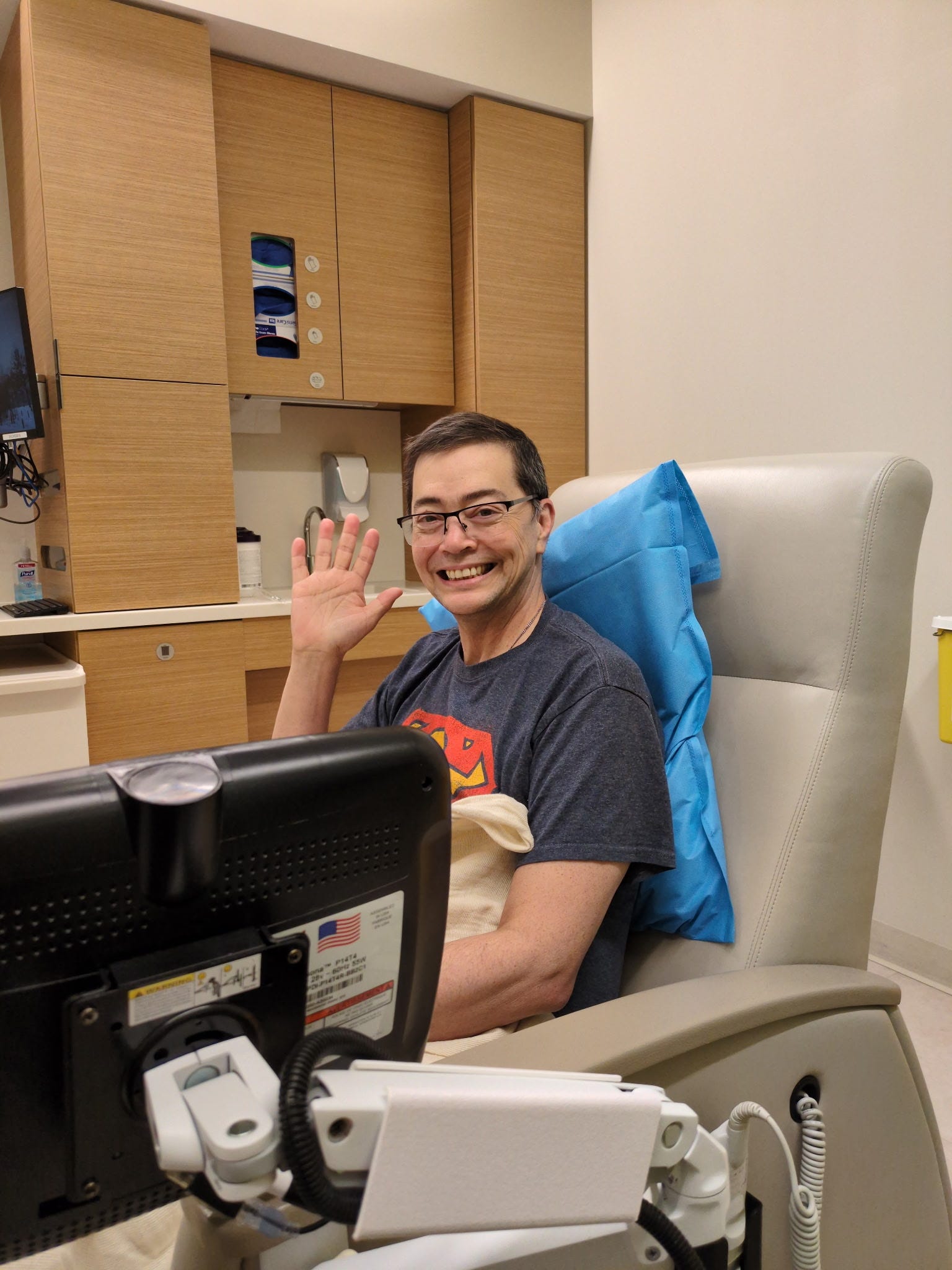
It has been quiet here in New York. I have been resting, eating, drinking, and healing. We are getting closer to my eventual return home to Virginia, and the thought of being near friends and family again fills me with excitement and motivation. This has been a long, winding road, and I am ready to step off it for a while. I want to explore the side paths. I want to breathe again.
I have not shared an update about my latest scan until now because we needed time to speak with several doctors first. The results showed no signs of my cancer spreading!
That is good news, and we are grateful for it. At the same time, I have to remember that I am still a “one of one” in terms of data. There is no clear roadmap for what recovery should look like at this stage. The doctors are watching closely, and so are we. For now, this is a positive sign, and we are holding onto that.
Maria and I have spent most of the past few weeks working quietly and staying inside. It has been bitterly cold.
We did manage to get out to see Aladdin on Broadway, which felt like a small gift in the middle of everything.
I have also started walking more. My legs are weak, and rebuilding strength and endurance takes patience. Four blocks is my limit right now before I need to rest. We did walk to the barber shop yesterday to get my hair cut. I felt the need to get my old hair style back, a low fade and cleaned up on the top. I wasn't sure what my hair was going to do post-chemo. I didn't get my afro, but I did get thinner and softer hair. It isn't as thick as it use to be, but there is still a lot on the top. It did have some wave to it, before I had it cut.
This weekend, my thoughts are with a fraternity brother and his young family. He received some difficult health news this week. A cancer diagnosis, in any form, is a heavy thing to carry. It arrives suddenly and changes the way you see time, plans, and even yourself. It brings fear, uncertainty, and questions no one is ever fully prepared to answer.
Having walked this road myself, I know how overwhelming those first days can feel. The shock. The waiting. The endless swirl of information and emotion. It can feel isolating, even when you are surrounded by people who care.
My hope is that he feels the strength of the brotherhood around him right now. That he knows he is not walking this alone. That he has people ready to listen, to sit quietly when words fall short, and to stand beside him through every step ahead.
No one chooses this fight. But no one should have to face it alone.
What follows is a brief summary of my journey. If you have been reading the blog, much of this will sound familiar. I began writing this around the one-year anniversary of becoming a cancer patient, but I never finished it.
A few days ago, I came across the draft again and realized I had forgotten all about it. I had started it with the intention of sharing it here, and it felt wrong to let it fade away unfinished. So, I decided to bring it back and finally give it the space it deserves:
January 2025 arrived quietly, the way most winters do.
Cold air. Short days. Familiar routines.
Then, without warning, my body began to unravel.
It started with exhaustion and pain that made no sense. My appetite disappeared. My strength faded. Blood work revealed dangerously high calcium. Scans showed blocked kidneys and a large mass in my abdomen.
I was admitted to the hospital.
Within hours, doctors were talking about lymph nodes, biopsies, and words that felt too heavy to carry.
On January 9, a needle found its way deep into my abdomen. The results suggested lymphoma. Steroids began immediately. Two small tubes were placed to drain my kidneys and give them a second chance to work.
Slowly, painfully, my system stabilized.
I was still standing, but barely.
A week later came another surgery. Another biopsy. Another round of opinions.
Pathologists leaned toward Hodgkin’s lymphoma. The NIH agreed, though they admitted it was difficult. Something about the cells did not quite fit.
It sounded like a foreign language. It felt like someone else’s diagnosis.
But it was mine.
I began reading everything I could about blood cancers and treatment options.
By February, treatment began.
Infusion chairs replaced office chairs. IV poles replaced coffee cups. I stopped going into the office as my immune system weakened.
Nivolumab and chemotherapy entered my veins. Three cycles. Three months of hope mixed with nausea and fatigue.
Every scan became a referendum on my future.
In April, the results came back.
The cancer was still there. Loud. Persistent. Unimpressed.
More biopsies followed. More waiting rooms. More careful conversations that started gently and ended with harder truths.
In May, we tried again.
Stronger drugs. Harsher side effects.
BV-ICE chemotherapy. Three rounds.
One hospital admission for sepsis.
Gout. Shingles. Bone pain. All at once.
Fevers. Alarms. Nurses who became temporary family.
More pills and drips to manage the damage.
We began preparing for a stem cell transplant at a major hospital. I would need to stay there for months. All three of my boys were tested as potential donors. All three were brave enough to say yes without hesitation.
Plans were made. Testing completed.
Then, one evening, a week before the process was to begin, the phone rang.
“We can’t help you right now.”
Less than thirty seconds. No explanation. No questions allowed.
We were stunned.
My oncologist, calling from Ireland, was stunned too.
In July, new scans showed the disease was still standing.
So was I. But we were battered.
My hair was gone. My left foot stopped cooperating. I learned a new term: drop foot. A result of chemotherapy and physical decline.
By late summer, the strategy shifted again.
Pembrolizumab and GVD chemotherapy. Two more rounds.
More infusions. More hope. More prayers whispered in quiet rooms.
We traveled to Memorial Sloan Kettering in New York City after speaking with hospitals about experimental trials. Many had been canceled due to lost funding.
In New York, we were met with kindness and compassion. Genuine care. I spent a week undergoing tests, scans, and procedures.
The scans showed some improvement.
Not enough.
A biopsy revealed only dead tissue. No living cancer cells. No victory either.
Only uncertainty.
A review of my earlier pathologies from the biopsies revealed something unexpected. I may have had Hodgkin’s lymphoma at first, but the evidence was never definitive. What was clear now was that I did not have it anymore. Instead, I was diagnosed with T-cell/histiocyte-rich large B-cell lymphoma, a rare and aggressive variant of diffuse large B-cell lymphoma.
Radiation followed.
Targeted beams deep and precise into my abdomen. Twenty-eight hundred units. Added in were a few doses of Rituximab.
One more attempt to corner what refused to surrender.
For a moment, it felt like we might have won.
We moved toward transplant. An international donor was found.
Then November came.
A PET scan revealed new spots in my spleen. Another near my salivary gland. Activity where there should have been none.
The cancer was still moving. Still adapting. Still surviving.
Biopsies were too dangerous. Surgery was impossible.
The conclusion was unavoidable.
Refractory.
Treatment-resistant.
Stubborn.
In December, everything changed.
CAR-T therapy became the next chapter, as well as joining a study: Pembrolizumab every 21 days for the next two years.
My immune cells were collected. Reengineered. Trained. Armed. Returned to my body on December 31, 2025.
A strange way to end a year.
A stranger way to begin hope.
Before infusion, chemotherapy wiped my immune system clean. Cyclophosphamide. Fludarabine. A controlled demolition.
Then came the reinforcements.
Day Zero.
A small bag of clear liquid. A nurse. A quiet room.
My cells.
Hope.
The days that followed were filled with monitoring and vigilance. Every headache. Every fever. Every strange sensation mattered. My body and immune system were learning how to fight together.
For a few hours, I lost myself.
I forgot who I was.
I forgot who the love of my life was.
That hurt the most.
Losing your memory is the most terrifying thing I have ever experienced. I often knew the answers, but the words would not match what was in my head. Sometimes I did not know. Sometimes I did not care.
By mid-January 2026, I returned for follow-up.
Day Twenty-Nine.
I stood up in the waiting room and nearly collapsed. Dizziness flooded in. My heart raced. My blood pressure dropped.
Deconditioning. Dehydration.
A reminder that survival is not the same as strength.
Fluids steadied me. My numbers normalized. I walked out on my own.
Tired. Healing. Uncertain.
But there.
Gout returned. Steroids followed. My appetite slowly came back. Movement returned in fragments. I weigh much less than when all this started.
This timeline reads like a medical record.
Biopsies. Infusions. Scans. Protocols. Regimens.
What it does not show are the long nights. The whispered prayers. The way Maria held my hand when words failed. The way my boys watched with quiet worry. The friends and family who carried me when I could not carry myself.
It does not show the fear.
It does not show the faith.
It does not show the stubborn hope that refused to die.
This is not just a record of treatments.
It is a record of survival.
It is the story of a body pushed to its limits and a spirit that refused to surrender.
It is still being written.
I am still here.
I am still fighting.
Jangus— yes, keep fighting; we are here for you!!! As you said, “No one chooses this fight. But no one should have to face it alone.” Keep the faith, we have your back —Odin
F@#K Cancer. Don’t ever think you are alone. You may not see us, but we are thinking about you. We are a phone call away.