

Warning - This one is a bit graphic. Pass on it, if you get nauseous about discussions of the urinary system.
Another chapter in the ongoing adventures of medical treatment.
Over the last couple of years, I've experienced more medical procedures than I ever imagined possible. I've been poked, prodded, scanned, infused, injected, and examined in ways that have made me reconsider the meaning of personal space. Somewhere along the way, I've developed a fairly high tolerance for discomfort. When you're dealing with two different types of lymphoma, you learn that some things are simply part of the journey.
Still, every once in a while, medicine finds a new way to surprise me.
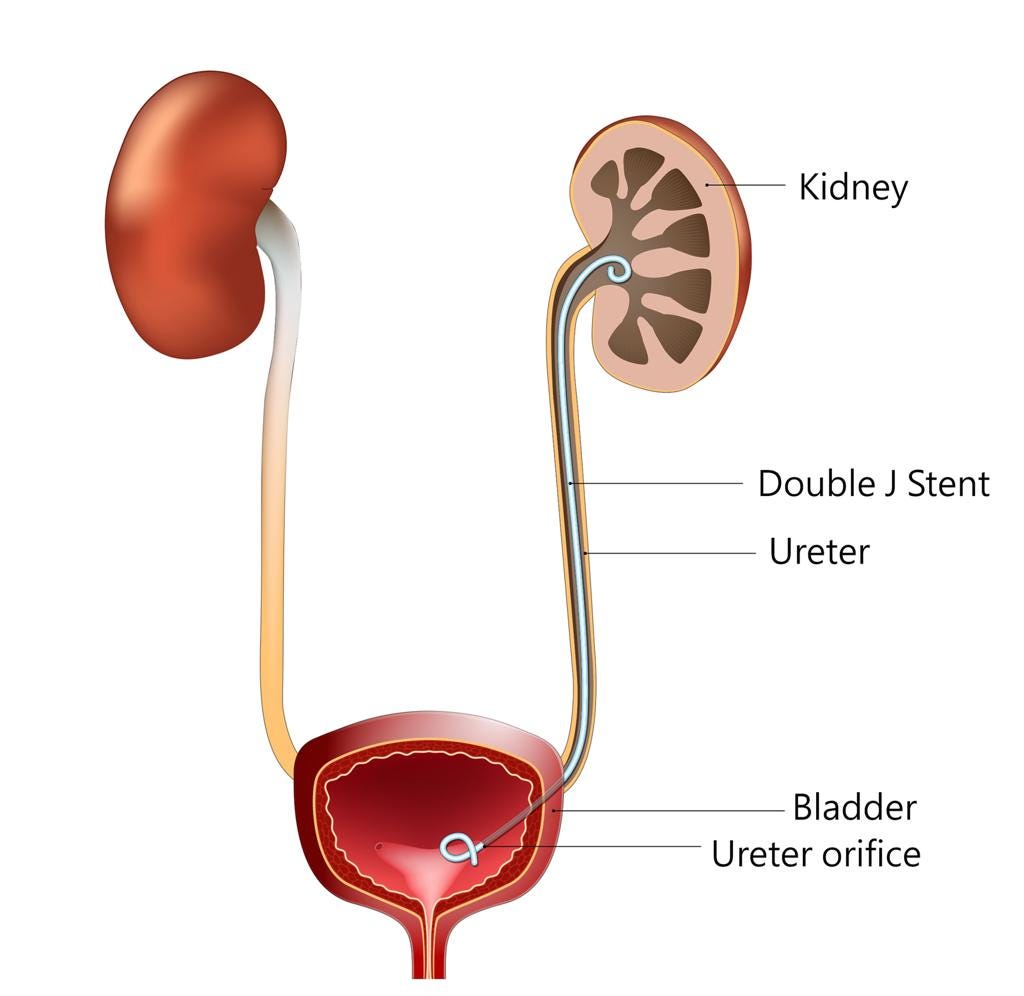
Last week, I had one of my two ureteral stents removed. For those unfamiliar with the plumbing of the human body, ureteral stents are small, flexible tubes that run between the kidneys and the bladder. They help keep urine flowing when something is obstructing the normal pathway. I've had two of these little devices keeping things moving, and my doctors decided it was time to see whether my body could manage without one of them.
Sounds simple enough, right?
The procedure is called a cystourethroscopy. That's a rather impressive medical term for inserting a small camera through the penis, up the urethra, and into the bladder. Once inside, the doctor locates the stent, grabs it with a small instrument, and pulls it out.
I'll give you a moment to appreciate that description.
I was awake for the entire experience. No sedation, no drifting off into a peaceful sleep, just me lying on an examination table, staring at the ceiling and contemplating the decisions that had brought me to this particular moment in life.
The first step involved a numbing agent. Now, when someone tells you they're going to numb an area before a procedure, you generally imagine something relatively straightforward. Perhaps a little topical medication or a quick injection.
In this case, the numbing medication was a gel introduced directly into my urethra through the opening at the tip of my penis.
Yes, you read that correctly.
I would like to take this opportunity to offer a small piece of constructive feedback to the medical community. A little communication before inserting anything into someone's penis would be greatly appreciated. I'm not asking for a formal briefing, a PowerPoint presentation, or a signed memorandum of understanding. Just a simple, "Here's what I'm about to do, and here's what you might feel."
There are certain moments in life when surprises are welcome. Birthdays, unexpected visits from old friends, finding a twenty-dollar bill in an old jacket. This was not one of those moments.
The numbing gel itself was an unusual sensation. There was pressure, a strange fullness, and the distinctly uncomfortable awareness that something was going somewhere it was never intended to go voluntarily. It wasn't exactly painful, but it certainly wasn't pleasant. It occupied that peculiar territory between discomfort and pain, where your brain is trying to decide whether to sound the alarm or simply register a very strong objection.
Then came the cystoscope.
Despite the numbing medication, I could feel the instrument moving through my urethra. There was pressure, occasional sharp discomfort, and a persistent sensation that I can only describe as deeply unnatural. At certain points, particularly as the scope moved farther along, I found myself gripping the examination table and concentrating on breathing.
I've spent a considerable amount of time practicing mindfulness over the last couple of years. Being present in the moment, appreciating the little things, and accepting what I cannot control.
For the record, I would have been perfectly happy to be somewhere else in that particular moment. Anywhere.
Once the doctor reached my bladder, she discovered that the two stents were somewhat intertwined. Apparently, even my medical devices have developed an attachment to one another.
She carefully identified what appeared to be the left stent, grasped it, and began removing it.
There is something profoundly unsettling about feeling an object being pulled out of your body through a pathway you generally don't spend much time thinking about. The sensation was a combination of pressure, pulling, and an almost indescribable internal discomfort. Not quite the sharp pain of an injury, but something that makes every muscle in your body want to tighten.
My brain had one very clear thought: I would like this to be over now.
Fortunately, the stent came out completely, and the right one remained in place.
The entire procedure didn't take particularly long, although time has a funny way of slowing down when you're the person on the examination table. What might have been only a few minutes felt considerably longer.
Afterward, I was left with some irritation, discomfort, and a renewed appreciation for the remarkable complexity of the human urinary system. I was also sweating profusely. My body couldn't figure out how to react to what just happened. I laid there for about fifteen minutes, sweating, anxiety filled, and reviewing my life choices. I was nauseous and just felt like crap. Maria was awesome as ever and dotted my head with a wet paper towel.
I was also reminded that the word "minimally invasive" is very much a matter of perspective. From the doctor's standpoint, this was a relatively routine office procedure. From my standpoint, there was nothing particularly minimal about the experience.
The good news is that my doctor was able to remove the left stent successfully. The plan is to check my kidney function after a week. If my creatinine remains stable, we'll move forward with removing the second stent the following week.
Yes, that means I may get to experience this all over again.
I'm trying not to think too much about that part.
All joking aside, I understand why these procedures are necessary. My body has been through a tremendous amount, and the stents have served an important purpose. Removing them represents another small step toward allowing my body to function on its own again. After everything I've experienced with cancer and its treatments, even something as seemingly mundane as removing a plastic tube feels like progress.
I've also learned that being a good patient doesn't mean silently enduring everything. Communication matters. Patients deserve to know what's about to happen to their bodies, especially when a procedure involves intimate or particularly sensitive areas. A few seconds of explanation can make an enormous difference in helping someone feel prepared and maintain a sense of dignity and control.
The medical professionals caring for me have been extraordinary throughout this journey. I appreciate their skill, compassion, and dedication. That doesn't mean there isn't room for improvement in how we communicate during procedures. Sometimes the smallest gestures, like explaining the next step before taking it, can have the greatest impact.
I suppose that's another lesson from this journey. Medicine isn't just about treating the disease or fixing the plumbing. It's about caring for the person attached to all those parts.
For now, one stent is out, one remains, and I'm hoping the next round of bloodwork brings good news. Every small victory counts, even the uncomfortable ones.
As for the procedure itself?
Zero out of ten. Would not recommend. Knock me out next time!
Unfortunately, I may already have a reservation for a second visit.